Before commercial real estate, Gayle Berkbigler, CCIM was one of five female oil and gas traders in Houston in the early 1990s. She came into CRE already knowing how to hold her position, read a room, and find a deal where others see a dead end. In the fifth She Does Deals session, she walked through what that looks like in practice — and why, nearly three decades in, she’s currently having the best year of her career.
Session 5’s theme — doing deals in heels — was not about prospecting, nor the life cycle of a deal, but the actual mechanics of making a transaction close when the path forward isn’t obvious. Negotiation. Creativity. Holding things together when they want to fall apart.
“Yes means yes. No means maybe. Maybe means yes,” she told the room — a line from one of her early mentors that she applies with appropriate nuance. “Of course, take that with a grain of salt.” But the underlying principle she came back to throughout the session was that the best deal-makers don’t just win points. They find a way forward, “knowing that getting the deal done is sometimes more important than winning every single term or point in that deal.”
She opened with an example from her own career to anchor the conversation. She recalled a 12-month effort working with seven attorneys to secure wet zoning approval from Tampa City Council for a waterfront property — the largest wet zoning application the city had ever processed, larger than the approval for Raymond James Stadium. The zoning was the obstacle standing between her and a land sale she had been working toward for two years, to a restaurant owner who couldn’t make the economics work without the right to serve drinks on the water. She got the full council approval, unanimous. The deal closed. “Recognizing a problem before it becomes a deal killer is something you need to learn in all negotiations,” she said. That one had been lurking for two years before she went and solved it.
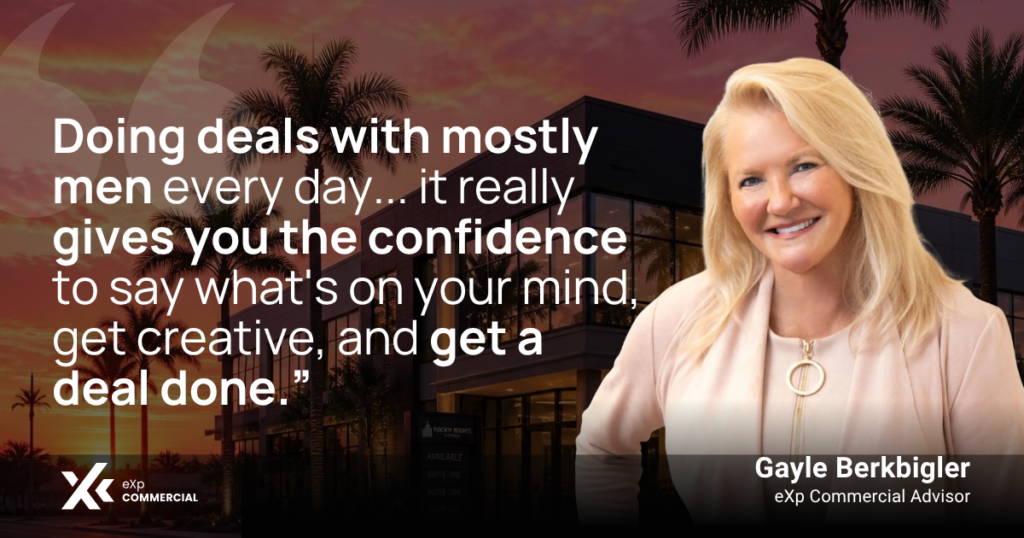
Gayle Berkbigler: Oil, Gas, and What 30 Years Across Two Industries Taught Her
Berkbigler’s commercial real estate career started with a friend asking her to list an attorney’s office condo on the top floor of a downtown Austin high-rise. She sold it. “I dove in,” she told the group. “I wouldn’t recommend going that way without education.”
Before that, she had spent 13 years as an oil and gas trader and marketer — one of only five women doing that work in Houston in the early 1990s. That environment built something she brought directly into commercial real estate. “Doing deals with mostly men every day, making little steps — it really gives you the confidence to say what’s on your mind, get creative, and get a deal done,” she said. The directness it required became her operating style: unfiltered, honest, sometimes to a fault by her own account. It also built the habit of not accepting the first no. She referenced the book Go for No as a framework she’s carried for years.
Golf played a role, too. She’s been playing since 13, her parents were avid golfers, her children play, and her 10-year-old granddaughter plays. In oil and gas, being able to play golf was the credential that got her a seat she wouldn’t otherwise have had. “I was the only female that was invited Friday afternoons to play with 13 or 14 guys,” she said. “It opened many doors.” And on the course, she could learn things about a client’s temperament that no boardroom meeting would surface. Mroczkowski made the same point from a different sport. At an annual executive leadership trip during her BTI years, clay shooting replaced golf. She turned out to be the best shot in the group. The men took her more seriously afterward.
Berkbigler earned her CCIM in 2013, after years of practicing without it and discovering, as she put it, that she didn’t know what she didn’t know. “I thought I knew it all because I had practiced so long. But I think therein lies the importance of acknowledging that.” She has served as president of the CCIM Central Texas chapter and has spent more than a decade raising money for CCIM scholarships.
The Negotiation Framework: Find the Pain, Work the Sweet Spot
Mroczkowski asked Berkbigler about her approach to negotiating a tough deal without turning it into a win-lose situation.
“Find the pain. Find the pressure points for the opposing side,” Berkbigler said. “Find the sweet spot and then work on that sweet spot.” The specifics of how she applied that came through in a deal she had just closed. It was a commercial property that had been listed by a residential brokerage, which created the first problem. The sellers had made significant improvements to the property without permits, and the residential agent hadn’t flagged it. Getting all those permits through the county would have taken six months to a year. The buyer was ready to walk.
Berkbigler’s team brought in a civil engineer, got an estimate of what legitimizing everything would cost, and used that number as the negotiating lever. The seller needed to close badly; another project was waiting on the proceeds. “We said, okay, you’re going to have to disclose all of this to somebody else if you put it back on the market. So why don’t you just reduce the price and we’ll take over.” The price came down hundreds of thousands of dollars. The deal closed.
“Every commercial deal has hair on it. You just have to work through combing that hair out,” said Berkbigler.
The buyer had needed to be talked off the ledge five or six times through the process. Berkbigler’s approach was to set expectations upfront, stay methodical, and reframe every complication as something to work through rather than a reason to stop. “Don’t panic. We’ll try to work through whatever comes up.”
Mroczkowski’s complement to that approach is to never give a client a single price or a single timeline. Every broker opinion of value comes with a low, middle, and high scenario — low if they need to sell quickly, middle for the realistic outcome, high if time is not a constraint — with corresponding timeframes attached to each. “When I talk to clients about the process, we’re setting expectations from the very beginning that this is what we think will happen, but be aware there are a lot of different variables.” No surprises or panicked calls when the first offer comes in below expectations.
The Toolbox: Think Like a Contractor, Think Like an Attorney
The civil engineer in Berkbigler’s deal was there because she’s built a deliberate network of specialists she can call depending on what a transaction requires. “It’s your team,” she told the group. Mroczkowski added to the principle, saying “think like an attorney. Think like a contractor. Don’t act like one because you’re not licensed. But have those people in your toolbox.” Land use attorneys, general contractors, civil engineers. Berkbigler called the one she needed, moved the deal forward, and closed it. She didn’t say “we can’t do it. Good luck.”
For Mroczkowski, the same principle applies at the brokerage level. She’s also a licensed GC, which means she can read a property’s physical situation in ways most brokers can’t. But even without that license, she told the room, anyone can learn to look up permits, identify violations, and flag issues before they surface in due diligence. “Think like them. Learn your local municipalities. Learn how to see if there’s any issues. Help yourself learn these properties and use the free tools at your disposal.”
The Best Year of Her Career — After Letting Go of Control
For nearly three decades, Berkbigler ran what she calls a “one-girl show.” Eight months ago, she hired her daughter full-time to handle all marketing and contract-to-close operations. She is incentivized with a percentage of each deal, and Berkbigler is now having the best year of her career.
“She does what I don’t do very well,” Berkbigler said. “And that leads me to do what I do best — negotiate and put deals together.”
The constraint Berkbigler had to overcome was her own instinct for control. “I’m kind of a control freak,” she said. “It’s hard for me to let go of everything.” But the moment she started delegating the parts of the business she was least efficient at, her capacity for the parts she’s best at expanded..
When to Walk Away — and What Women Do Differently in the Room
Former guest and attendee, Leigh Brower asked Berkbigler how she knows when to walk away from a deal?
“Follow your gut,” Berkbigler said. “If it feels like a waste of time, it is a waste of time.” At her current volume, she’s become selective in a way she couldn’t afford to be earlier in her career. Smaller deals that require disproportionate time relative to the commission are declining. “You could be doing two or three more with the time you wasted on one deal.”
Mroczkowski added, “Don’t count your commissions till they’re in your bank account. But I do think people should look at the time value of what each deal will realistically bring in — because you could spend six months showing 50 properties to someone and only make three or five grand on it, and it’s not worth your time.”
The session’s final thread came from a question about negotiation style and whether women adjust their approach based on who’s across the table. Berkbigler’s answer was that she operates in what she called her “masculine mode” during deal-making regardless of the counterpart. Direct, honest, unfiltered. “Sometimes people get offended because I’m so direct. But, it’s just the way I do business and it seems to work well.”
Mroczkowski offered a nuance, explaining that when she’s negotiating with women she knows in the Tampa market, she finds deals close faster. “I can call her up and say, ‘Hey, what do we need to do to get this done?’ without giving away our cards. Women answer the phone more, I’ve found. Deals get done a bit faster because they don’t sit in the inbox for a few days.” Berkbigler confirmed the same: “You can reason with women and say, ‘What do we need to do? Let’s get creative here.'”
What attendees took from Session 5
- Find the other side’s pain before you propose anything — the creative path forward is usually hidden inside what they actually need, not what they’re asking for.
- Creativity in non-monetary terms preserves the rate — parking, patio space, buildout periods, and TI adjustments can solve a tenant’s real problem without touching the rent.
- Set three scenarios, not one — low, middle, and high valuations with corresponding timeframes prevents client panic when reality meets expectations.
- Every deal has hair — the job is to comb it out. Guide clients through complexity with a calm, methodical posture rather than treating complications as reasons to stop.
- Build your specialist network before you need it — civil engineers, land use attorneys, GCs. The broker who can call the right person at the right moment holds deals together that others lose.
- Delegate what you do worst, protect time for what you do best — Berkbigler’s best year came from finally letting her daughter handle marketing and contract-to-close operations so she could focus entirely on deals
- Follow your gut on walking away — if a deal feels like a time sink, evaluate the realistic commission against the hours it will take; protect your capacity for the deals worth closing
How to Get Involved
Masterminds like this are rare in commercial real estate. That is the point and the gap Mroczkowski is deliberately closing.
She Does Deals is built for the conversations that don’t happen at all brokerages, such as where you made the mistake, what it cost, and who has been through the same one and come out the other side. The deal flow that follows from those connections is a byproduct. The relationships — advisors who become colleagues, mentors, and peers — are the product.
The series is open to all professionals, inside and outside eXp. The next session is happening on September 30. Add it to your calendar, and join the discussion.
Part of an ongoing series. Read Session 1, Session 2, Session 3 and Session 4.