The fourth She Does Deals session opened with a proper introduction of its host. Four sessions in, Britney Mroczkowski walked the room through the full arc of her experience — Colliers, 43 listings left on the table, VP of retail development at BTI Partners, the 52-acre mixed-use waterfront project she oversaw at 28 after two layers of management above her were removed, the GC license she earned under pressure, and eventually eXp Commercial. “I have the tools to help my clients with the entire life cycle of the deal,” she told the group. “Looking at it from all angles. That is what makes me a better broker.”
That context mattered for what followed. The session’s theme — the life cycle of a deal — is one that both Mroczkowski and guest speaker Mallisa Jackson have experienced from multiple angles as tenant reps, landlord reps, and developers who’ve had to rebuild deals from scratch when the market moved against them.
Mallisa Jackson: What a Decade at Colliers and a COVID Development Deal Taught Her
Jackson’s background is in the restaurant space. She ran restaurants and fixed underperforming operations — systems, staffing, conversion rates — until she ran into an issue she couldn’t fix. Because, it wasn’t an operations issue. It was a real estate issue. The location was wrong. That observation sent her into commercial real estate, first at Cushman and Wakefield, then to Colliers, where she spent roughly a decade on their retail team.
At Colliers, she learned to approach transactions not as an agent or a salesperson but as a consultant. “What is your long-term plan? If you are McDonald’s, how do you pace your stores? How do you place them so they don’t cannibalize each other? How do you get the ideal demographic for your employees?” That macro perspective — seeing the whole chessboard rather than a single transaction — shaped everything she’s done since.
She joined eXp Commercial after approximately two years of consideration, drawn by the ability to operate nationally and collaborate across states in a way that wasn’t possible at a traditional brokerage. “When I was at Colliers, I could do up to 10 deals a week,” she told the group. “But I was doing that primarily in the state of Idaho. It’s been fantastic to collaborate with people in multiple other states and learn how to apply what I’ve been implementing across different markets.”
Why Not Everyone Makes It in Commercial Real Estate
Mroczkowski asked Jackson what she discovered through years of studying why some practitioners consistently succeed and others consistently struggle. Jackson explained that statistically, the majority of people who try to break into commercial real estate don’t succeed. The primary reasons, in her analysis, are education and mentorship — two gaps that have defined her coaching work.
But beyond those structural issues, she identified a more fundamental behavioral divide. “You have to be relentless,” she told the group. “I’ve called somebody multiple times in one day. I’m like, ‘Hey, you want to do this deal with Trader Joe’s?’ And he’s like, ‘You’re a pain…’I’m like, ‘Yeah, but imagine how many times I’m calling the prospects trying to land in your developments.'”
The second failure mode is having only half the skill set. “You typically have somebody that’s really good at asset management that doesn’t know how to sell, or somebody that’s really good at sales that doesn’t understand the economics, asset management, or commercial real estate fully,” she said. “You have to become both. You have to understand the economy, know what the Federal Reserve is doing, understand cap rates, yields, construction costs — and you also have to understand the psychology of sales, how to negotiate, how to cold call. Because if you know everything but have no clients, you’re not going to succeed. And if you have a bunch of clients but don’t know how to serve them, that’s not success either.”
Mroczkowski added a layer from her own experience: “If you answer your phone, you’re going to get the deal even if it’s not the best property. We’re in Florida in the summer. Every commercial broker is on a golf course or a boat.”
Prospecting Maturing Loans — and Why Timing Is Everything
A South Florida advisor who had recently quit her day job to go full-time in commercial real estate was in the session and opened the floor with a specific question. She had found owner-occupied properties on CoStar with loans coming due and wasn’t sure how to approach the owners. The conversation that followed was one of the most tactically useful exchanges in the session.
Mroczkowski validated the strategy immediately. “Maybe they don’t qualify anymore for a new loan. Maybe they’re going to be forced to sell the property. And if that were the case, you could potentially get two deals out of it — helping them sell, and maybe they have to lease somewhere else for their business.” The frame she offered was don’t lead with “do you want to sell?” Lead with “I’ve been doing market research for you.”
eXp Commercial Director of Brokerage Operations John LeTourneau advised attendees to build a database of lenders first. Run the refinancing scenarios. Then approach the owner with concrete options rather than a leading question. “You’re coming from contribution and adding value instead of, ‘hey, do you want to sell your building? I know you’re stuck and really in trouble.’ That’s a pretty vulture-y way to approach it.”
On timing, Mroczkowski suggested 12 to 18 months before maturity as the target window — before owners have started thinking about it and before competing brokers run the same CoStar search. Denise Clemence, attending as a participant and drawing on her 20-plus years in SBA lending, suggested “At least nine months. Lenders typically require 60 to 90 days for processing, and owners often haven’t filed their tax returns — and you cannot get a loan without current tax returns.” She followed up with a note on persistence, encouraging participants to call every 30 to 45 days after the initial outreach. “Don’t expect them to respond right away.”
LeTourneau added using the end of the tax year as one more leverage point. If an owner is 12 to 14 months out from a maturity date, there’s a narrow window between now and year-end to improve operational documentation — rent rolls, expense tracking, NOI — before the lender leans on those figures. “Use the tax year as a leverage point to get a good year of operational returns out there,” he said.
Development Underwriting: The Questions You Have to Ask Before the Site Visit
Jackson’s approach to development starts before any site visit or contract. She runs what she calls a “runs clear test” for every party in a development transaction — qualifying the developer, investor, tenant, and landlord before committing to the project. The first question she puts to any developer: how much pre-leasing do you need before you feel comfortable moving forward? “Is it 50% or 75%? I do that because developers will often try to move that needle right before due diligence gets waived and rush you to find a new tenant.”
On the economics side, she starts with land basis. In her current market in Idaho, pad-ready retail land runs roughly $40 per square foot. At that basis, the rents needed to make a project pencil come out around $55 to $60 per square foot for shop space. The question she then has to answer is can the tenant actually afford to pay that rent, or will it bankrupt them? “I need to know the sales numbers of surrounding retailers. I need to know what retailers are already in the market. I need to know that I can get enough commitment during due diligence that this isn’t a nothing burger.”
Mroczkowski described the same analytical instinct applied to leasing. She maintains a proprietary Excel model built over years that runs TI allowances, rent abatement, and base rent against a tenant’s projected economics. “Can this tenant afford this rent? Because if the tenant’s not successful, the landlord’s not successful, and the entire project fails.”
On void analysis and market tools, both Mroczkowski and Jackson were specific. Mroczkowski’s process is to map competing centers within the relevant radius, identify what uses are present, and find the gap. If eight pizza concepts operate within half a mile of a restaurant space, the void isn’t pizza — it’s whatever isn’t represented. Jackson’s tool recommendation is Placer AI, which provides consumer behavior data and estimated sales figures for existing retailers. “I’m working on a project in Caldwell, Idaho, and the void analysis is showing about $6.7 million in consumer spending leaving to go to a different gas station area,” she said. “That tells you exactly what the market needs.”
What a COVID Development Crisis Looked Like from Inside It
Jackson’s most instructive story from the session involved a project she had been building since 2019 — a retail development at what she described as the second-busiest intersection in Idaho, which her colleagues had told her was impossible to pull off because of a famously resistant seller who had vowed never to sell to an out-of-state developer. She hit 75% pre-leasing. Then COVID happened.
The developer, who had gone hard with roughly $200,000 in earnest money, pulled out. The seller wouldn’t put the property under contract again. The purchase and sale agreement, however, contained the right to assign. Jackson had less than 30 days to find a new developer willing to assume the PSA — past the due diligence period, with no free time to negotiate. They found one. Then they had to resign every single lease, because each had been contingent on the original developer closing. By 2021, with 40% of all US dollars in circulation having been printed that year, every lease economics had changed. They renegotiated them all.
The new developer’s lender didn’t like retail. Jackson needed a 10,000-square-foot tenant to satisfy the bank — sourced through cold calls, during a period when bar and event concepts in her state were still locked down. She found one. Secured a half-million-dollar security deposit to satisfy the lender. Closed the deal.
“Nearly every single one of those leases was based off cold calling, prospecting, and working the brokerage community,” she explained.
Mroczkowski’s parallel from the same period was a retail town center project with a $100 million loan closing expected the same week the world shut down. Six of twelve leases signed. Every tenant asked to cancel. She kept every one — without reducing the rent by a dollar. “I offered them more patio space, extra parking, a little more TI on some of them. But I did not reduce that rental rate $1. When you get the hard answers in commercial real estate, negotiate back. Be resourceful.”
The Sales Cycle: Hope Is Not a Strategy
Jackson closed her session with the piece of advice she said comes from watching practitioners fail in real time. Most brokers, she says, do not manage a sales cycle. They manage hope.
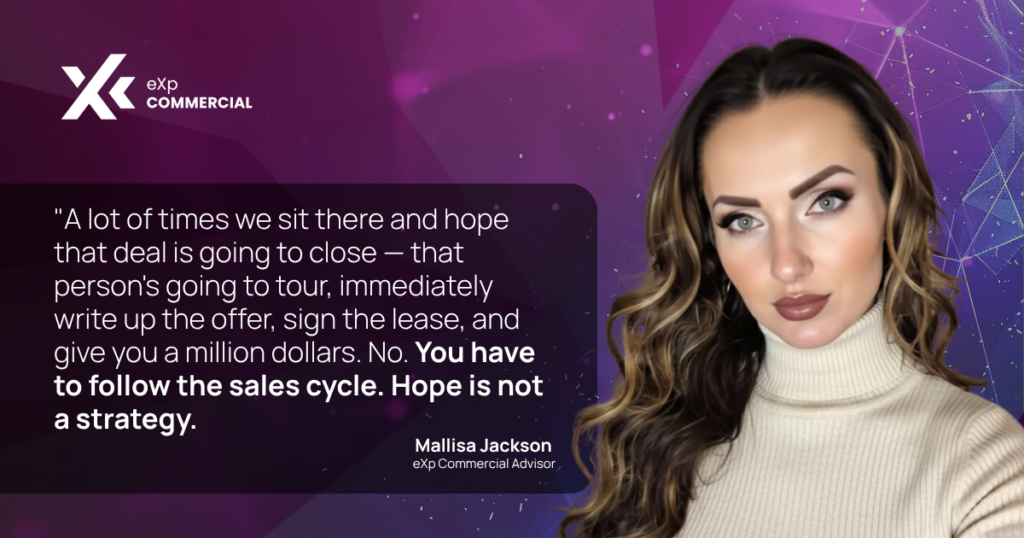
“Interested. Touring. Letter of intent. Lease negotiations. Signed lease,” she laid out. “A lot of times we sit there and hope that deal is going to close — that person’s going to tour, immediately write up the offer, sign the lease, and give you a million dollars. No. You have to follow the sales cycle. Hope is not a strategy.”
The specific process she uses includes tracking where every prospect sits in the cycle. For those who have declined a site, break them into a separate section and document their objections. “They said no because you haven’t handled their objections. Figure out what they’re saying no to and combat it with market knowledge, insights, and research.” She has turned a no into a yes in about ten minutes using nothing more than Google Street View and market data. Knowing your market precisely is what makes that possible.
Key Takeaways From Session 4
- Prospect maturing loans 12 to 18 months out — before owners are thinking about it and before competing brokers run the same search; follow up every 30 to 45 days
- Come with refinancing options, not just questions — build a lender database first, run the scenarios, then approach owners with concrete data rather than a leading pitch
- Use year-end as a leverage point — a narrow window exists between now and December to help owners clean up operations, NOI, and documentation before lenders lean on those numbers
- Know your land basis before you know anything else — in development, whether rent rates can support the land cost determines whether the entire project is feasible
- Void analysis is the prospecting tool most brokers skip — map competing centers, identify gaps in the market, and let the void drive tenant targeting.
- Manage a sales cycle, not a hope — track every prospect by stage; document objections from those who pass and treat each one as an unhandled problem to solve
- Answer the phone — in summer, on holidays, when other brokers aren’t working; it remains a true competitive advantage
- Get your commission in writing — if it is not documented, it does not exist; off-market deals especially require this before any outreach begins
How to Get Involved
Masterminds like this are rare in commercial real estate. That is the point and the gap Mroczkowski is deliberately closing.
She Does Deals is built for the conversations that don’t happen at all brokerages, such as where you made the mistake, what it cost, and who has been through the same one and come out the other side. The deal flow that follows from those connections is a byproduct. The relationships — advisors who become colleagues, mentors, and peers — are the product.
The series is open to all professionals, inside and outside eXp. The next session is happening on August 26. Add it to your calendar, and join the discussion.
Part of an ongoing series. Read Session 1, Session 2, and Session 3.